Shipped worldwide · A new piece every fortnight.
How to style the cowl-neck gown — the quiet power of a bias drape

Some silhouettes announce themselves. The cowl-neck gown does something quieter. It pools softly at the throat, follows the body without gripping it, and moves when you move — a piece that reads as ease and turns out, on closer inspection, to be the most considered thing in the room.
Most of that quiet power lives in the cut. Below, the house on why the bias flatters almost everyone, how to think about jewellery, the honest foundations conversation, and the alterations that take a beautiful drape and make it yours.

Why the cowl and the bias flatter almost everyone
Cut a fabric on the bias — diagonally, across the grain — and it stops behaving like cloth and starts behaving like water. It stretches gently where the body curves and relaxes where it doesn't. The result skims rather than clings. It grazes the high points and glides past everything in between, which is why the bias has flattered every decade it has appeared in.
The cowl neckline is the same logic worn higher. Soft folds gather at the décolletage and drape into shadow and light, drawing the eye up to the face and softening the line of the shoulder. Satin does the rest. A bias-cut silk satin catches light along the fold and lets it fall away, so the fabric appears to shift as you cross a room. Nothing is tight. Everything is intentional.
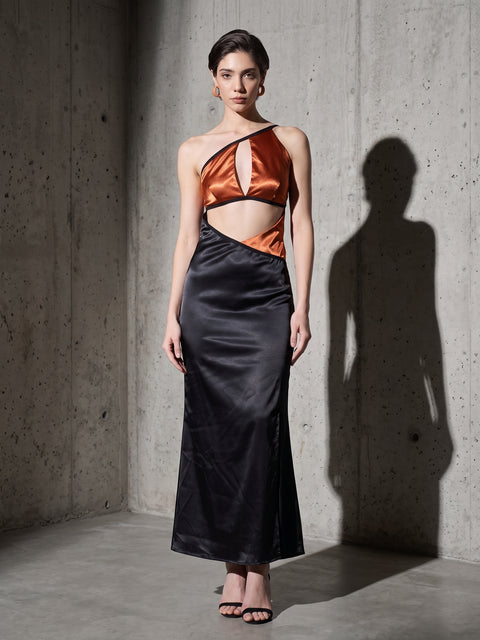
The Liquid Onyx Cowl Neck Gown is the definitive expression of it — black silk satin, a bias fall from shoulder to floor, a cowl deep enough to read but never overstated. If you own one cowl, it is this.
A bias drape doesn't demand the room's attention. It earns it slowly, over the length of an evening.
Jewellery logic — read the neckline, then the back
A cowl leaves the décolletage bare and softly sculptural. It has already done the work a necklace usually does, so a necklace competes with it. Leave the collarbone clear and let the earrings carry the look — something sculptural and considered, a drop or a bold stud that answers the fold of the fabric rather than fighting it.
Then check the back. Many cowls fall to a low or open back, and there the rule is simple: skip the necklace entirely. A chain that migrates down an open back rarely sits the way you hoped, and it interrupts a line the design intends to keep clean. Let the skin and the drape be the statement.
Styling note
One metal, chosen with intent. Match earrings to a fine bracelet or a single ring and stop there. On the Liquid Onyx, cool-toned silver keeps the mood modern; warmer metals soften it. Either works — mixing all of them does not.
The honest foundations conversation
Here is the part most guides skip. A bias cut reveals everything beneath it. That is the whole point of the fabric — it follows the body faithfully — but faithful means it will trace a seam, a band, or a hemline underneath just as readily as it traces you. So the rule is smooth lines, always.
Seamless or nothing. A truly seamless piece with no edges to print through, or, if the design supports it, nothing at all. Avoid anything with structured seams or a decorative edge; the satin will find it. Consider fabric-friendly tape at the shoulder or bust for security without bulk. The aim is an unbroken line from neckline to hem, so the drape reads as one continuous fall.
Styling note
Test in daylight, not just under a bathroom bulb. Stand by a window, move, sit, and look at the line from the side. Bias fabric behaves differently in motion than at rest — what looks smooth standing still can shift once you walk.
Colour, and a cowl for every register
Black is the discipline; colour is the pleasure. The Bordeaux Cowl Gown takes the same drape into a deep, saturated bordeaux and adds a halter-neck cowl that frames the shoulders and keeps the back long and open — a warmer, more romantic register for the same occasion. It is the one for a room lit by candlelight.

For those who want the softness of the silhouette without the solemnity, the Blue Piscean Maxi carries a print across the same fluid cowl — colour and movement together, for the occasions that ask you to be seen a little more. Three cowls, three registers, one quiet idea.
Day to evening, and altered to you
A cowl is more versatile than its reputation suggests. By day, a tailored coat or a fine knit thrown over the shoulders reins in the drama and lets the drape read as understatement. By evening, drop the layers, let the satin fall, and the same piece becomes the whole statement. If you need the full grammar of the occasion, our black-tie guide covers the rest.
The final refinement is fit — and this is where the drape is truly won or lost. A bias gown lives on two measurements: the set of the shoulder, which governs how the cowl falls, and the hem, which governs the length of the line to the floor. Our alterations are complimentary, so we take both in at the shoulder and settle the hem to your exact height in heels. Adjusted this way, the fabric hangs from precisely the right points and reads as though it were cut for you. Because, effectively, it was — altered to you, so it becomes one of one.
The edit
The cowl is a study in restraint that never reads as plain. Begin with the Liquid Onyx and let it teach you the silhouette; move to the Bordeaux for colour, or the Blue Piscean for print. See the full range in the gowns, and for the pieces the house returns to season after season, the signature collection. Couture-grade drape, altered to you, with 14-day returns should the piece not be the one. Quiet power, within reach.